Best AI Agent Integration Platforms in 2026: A Full Breakdown
AI agents are in production now, and every one of them needs a reliable way to call APIs, pull CRM data, and update records without breaking the moment a token expires. In this article I'm covering how integration platforms differ from plain function calling, why MCP matters, where Nango, Arcade, Composio, and the iPaaS crowd actually fit, and what I'd build on in 2026.
Software
5 min
AI agents are out of the demo stage. Businesses are shipping them into production, and every one of them needs a reliable way to talk to the outside world: calling APIs, pulling data out of a CRM or an ERP, updating a record in Salesforce, or posting in Slack, without falling apart the moment a token expires.
That's the job of an AI agent integration platform. It handles authentication, execution, and monitoring so the agent isn't guessing its way through raw API docs. In this post I'm covering what these platforms are, how they're different from plain LLM function calling, which ones are worth your attention in 2026, and a full review of Nango.
What Is an AI Agent Integration Platform?
An AI agent integration platform is infrastructure that connects AI agents to external systems, APIs, and data sources so they could take real action instead of just generating text. It manages authentication, turns messy API responses into clean structured tool calls, and enforces the governance and audit logs a production system needs.
Large language models reason probabilistically. APIs are deterministic and unforgiving. Hand an agent a raw OpenAPI spec and it has to manage business logic and guess at parameters it doesn't understand. An integration platform pulls that deterministic logic into code, so AI agents get a small set of reliable, outcome-based tools instead of an entire API surface to interpret on the fly.
What Are Agentic AI Platforms?
Agentic AI platforms are the wider category of tools used to build, orchestrate, and run autonomous AI agents. That umbrella covers a few very different architectures:
Developer frameworks like LangChain, LangGraph, and CrewAI. Maximum control, but your team owns the infrastructure and the authentication.
Ecosystem agent builders like Salesforce Agentforce and Microsoft Copilot Studio. Great inside one platform, friction the moment an agent reaches outside of it.
Unified APIs, iPaaS, and embedded iPaaS like Merge.dev, Paragon, Workato, Zapier, and Knit. Standardized schemas across a category like HRIS or CRM, built for one-way syncing rather than dynamic agentic AI workflows.
Agent-native runtimes like Nango, Arcade, and Composio. Purpose-built for authorization, tool calling through the Model Context Protocol (MCP), and secure execution for AI agents.
What Is MCP and Why Does It Matter for AI Agents?
MCP, the Model Context Protocol, is a standard that lets AI agents discover and call external tools in one consistent way. Before a shared protocol, every new API meant glue code for that model, that tool, and that authentication flow. Now a platform exposes hosted MCP servers, and any compatible agent could query one to see what tools are available and run them securely.
The second reason it matters is security. A well-built MCP gateway filters which tools an agent or user is even allowed to see on a tools/list request, based on identity and policy. A basic MCP proxy just forwards the request. A true gateway enforces identity, tool-level policy, routing, and audit trails on every request.
What Is a Unified API for AI Agents, and Why Does It Matter?
A unified API standardizes access across many similar tools in one category, say dozens of different CRMs, so you write integration code once against a single schema instead of once per vendor.
The tradeoff shows up when AI agents need to act, not just read. Unified APIs use rigid, generalized schemas that break down for outcome-specific agentic AI workflows, and they're usually priced per connection, which gets expensive fast at thousands of end users. Reasonable for one-way sync across a lot of similar tools. A weaker fit for precise, custom tool calling an autonomous agent could run reliably.
How Is an Agent Integration Platform Different From LLM Function Calling?
LLM function calling is a model capability. The model decides which function to call and with what arguments, based on a schema you put in the prompt. Function calling by itself doesn't refresh expired tokens, doesn't handle pagination on a background sync, and doesn't produce audit logs for a compliance review.
An integration platform sits underneath function calling and does the work the model can't and shouldn't do. It keeps tokens out of the model's context window, which limits the blast radius of a prompt injection attack, validates inputs before they hit an external API, and retries safely when a rate limit hits.
The 2026 AI Agent Integration Landscape
The stakes in agentic AI are higher than they look. Integration platforms hold the production access keys to a company's entire external software footprint, and that risk isn't theoretical. In May 2026, Composio disclosed a serious security incident. Attackers compromised an employee email account, reached an internal monitoring tool through magic-link authentication, and registered malicious tool definitions inside the execution sandbox. The result was 5,241 API keys and more than 5,000 GitHub OAuth tokens exfiltrated. Since then, enterprise buyers have leaned hard toward hardware-level tenant isolation and bring-your-own-cloud deployment.
Gartner projects that more than 40 percent of agentic AI projects will be shelved by 2027. Most of those failures aren't about model quality. They're about governance, authorization, and integration work the team underestimated once the pilot moved past its first demo.
What Are the Best Platforms for Integrating AI Agents Into Applications?
Here's a practical rundown of the platforms that come up most in 2026, grouped by what they're actually built to do.
Nango is a code-first integration platform built for AI agents, with over 1000 APIs and more than 7,000 pre-built tool calls. Full review below.
Arcade is an MCP-native runtime built around delegated user authorization, scoping credentials tightly per tool. It's a strong fit for regulated environments that need VPC or air-gapped deployment, but it doesn't currently support background data syncs or webhooks, which rules it out for RAG pipelines.
Composio offers a huge hosted catalog of over 1,000 toolkits that wrap complex API calls into typed Python or TypeScript functions. The catch is a closed-source runtime, and governance features like action-level role-based access control sit behind its top enterprise tiers.
LangChain, LangGraph, and CrewAI give engineering teams a code-first way to orchestrate multi-agent systems. They're developer frameworks, not managed integration infrastructure, so you're still building or buying managed authentication and execution on top.
Workato and Zapier lean toward broad workflow automation and iPaaS-style connectivity. Zapier is great for wiring a form to a spreadsheet, and Workato is great for enterprise workflows across an ERP and a CRM, but neither is built for agent-native tool calling where the model makes the decisions.
Merge.dev, Paragon, and Knit round out the unified API and embedded iPaaS category, standardizing schemas for HRIS, CRM, and similar tools. Efficient for one-way sync across many vendors, rigid for the custom tool calls agentic AI workflows increasingly need.
Nango Full Review: Architecture and Capabilities
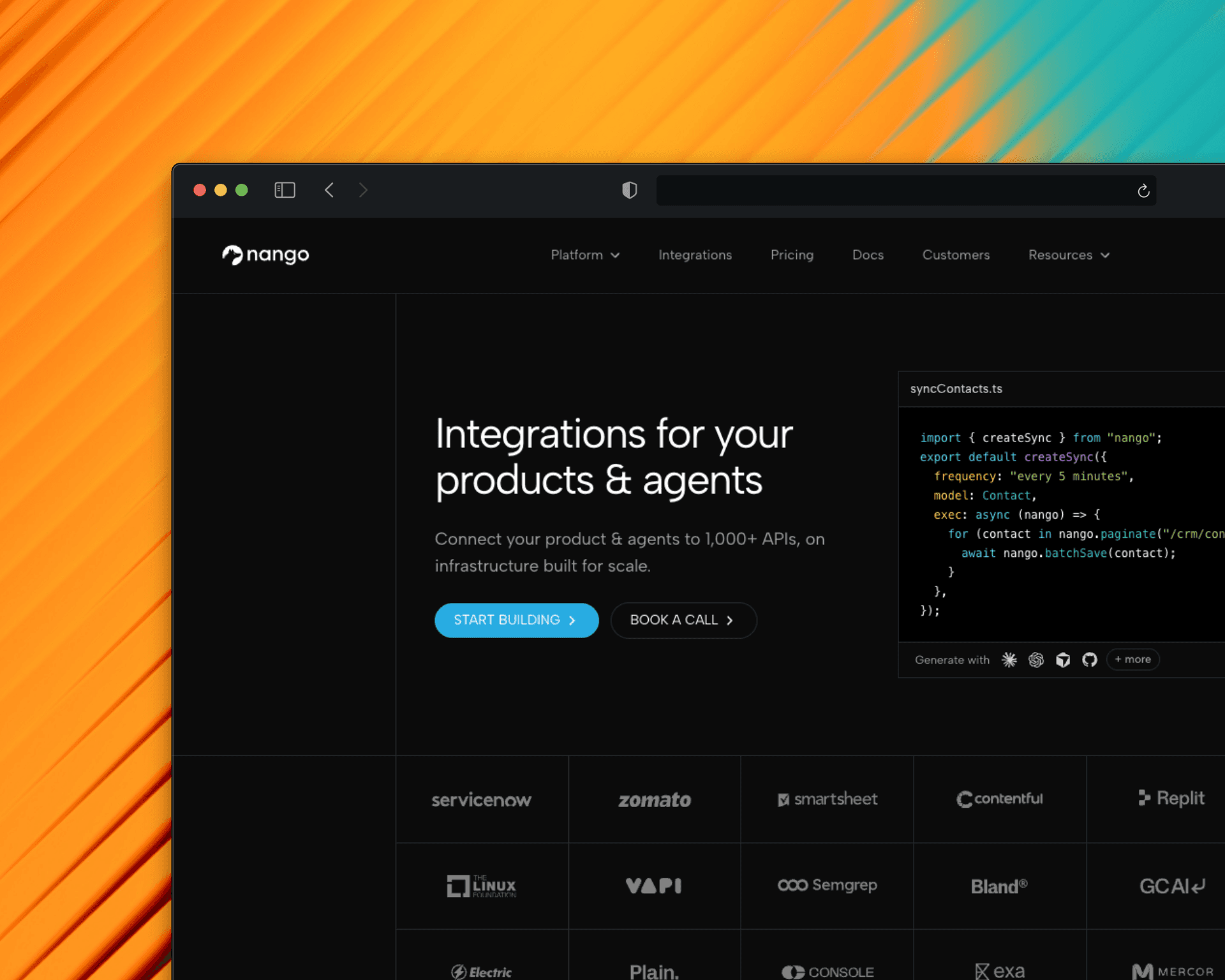
Nango connects your products and agents to 1,000+ APIs. It provides 7,000+ pre-built tools and covers every integration type: auth, tool calls, triggers, and syncs. You can get started in 10 minutes, then extend infinitely on a platform built for scale. Coding agents such as Claude Code, Cursor, and Codex can write the integration code.
Authentication and Security
The foundation is managed authentication that covers the complete credential lifecycle: OAuth handshakes, API keys, dynamic client registration, and automatic token refreshes. Every credential is encrypted and stored inside the platform's infrastructure, so sensitive tokens never sit in the LLM's context window. The agent only ever receives an execution reference, not the underlying token, and that directly limits how much damage a prompt injection could do.
Deterministic Tool Calling
For real-time work, the platform uses Action Functions: custom integration logic written in TypeScript and deployed to its runtime. When an agent needs to update a Salesforce record or issue a Stripe refund, the matching function runs for a specific user connection. Those functions are natively translated into MCP, so developers get a single hosted MCP server URL that agents could query to discover and run tools.
A few design rules do the heavy lifting here. Design tools around user intent instead of raw endpoints, so a few API calls get grouped into one outcome-based function like upsert_contact. Return structured error hints so the agent could self-correct on the next try. And filter tools dynamically, so an agent sees only the subset relevant to its product context. Together those constraints push deterministic execution into code, and that's what drives down token cost and latency at scale.
Data Sync and Observability
Beyond real-time tool calls, the platform supports durable background data sync: pagination, deletion detection, and stored data for RAG pipelines. A checkpoints feature saves progress after each page, so a transient network failure doesn't force a full resync. On the observability side, it logs audit trails for auditing and integrates with OpenTelemetry, which matters for any team that has to answer "what did this agent actually do" after the fact.
MCP Gateway Capabilities
Nango works as a full MCP gateway, not a basic proxy. It enforces identity, tool-level policy, routing, and audit logs across all agent-to-tool traffic, and filters what an agent sees on a tools/list request based on the authenticated user. It also automates dynamic client registration for complex OAuth 2.0 flows. For platforms like Notion, Linear, and Render, it discovers OAuth endpoints straight from the remote MCP servers' authorization metadata under RFC 8414 and RFC 9728, so nobody is pre-configuring client credentials by hand.
Agent sessions:
Nango’s new agent sessions feature gives your AI agents scoped access to integrations. Your backend creates a session that sets the tenant and toolset, and Nango then returns a dedicated MCP server for that session. The agent never sees credentials and can't widen its own scope.
AI-Assisted Development
Nango also ships an AI Builder Skill that works with Claude Code, Cursor, and Codex, injecting the platform's constraints and current API documentation straight into the coding agent's context. In internal benchmarks, coding agents on this scaffolding generated and tested roughly 200 integrations across five enterprise APIs, including Google Workspace, Salesforce, and HubSpot, in about 15 minutes for under $20 in LLM token cost. That's what makes a just-in-time strategy realistic: build the HubSpot connection when a customer asks for it, instead of pre-building against every API you might ever need.
Execution Security
Running untrusted, customer-supplied TypeScript at more than 150 million function executions a month takes serious isolation. So the platform moved its execution layer entirely to AWS Lambda, where every function runs inside a hardware-virtualized Firecracker microVM, isolated at the kernel level. Warm instances are pinned to a single tenant, so an environment is never reused across customers. That closes off the exact cross-tenant risk that made the Composio incident so damaging.
Compliance and Pricing
The managed cloud is SOC 2 Type II, GDPR, and HIPAA compliant, and it supports bring-your-own-cloud deployment inside your own AWS, GCP, or Azure environment. Pricing is usage-based rather than per connection: free to start and then pay-as-you-go. It is open-source license, and the free self-hosted edition covers core authentication and API proxy. The MCP server, continuous syncs, webhook processing, and OpenTelemetry exports on self-hosted infrastructure require an Enterprise license.
Frequently Asked Questions
What is the best AI platform for agents? For maximum control over multi-agent reasoning in code, LangGraph or CrewAI are strong developer frameworks. For a managed layer that handles authorization, hosted MCP servers, and background sync for AI agents, Nango is one of the most complete code-first options in 2026.
Which AI is best for integration? Agent-native runtimes like Nango, Arcade, and Composio are purpose-built for connecting AI agents to outside APIs. The pick comes down to whether you need background syncs (Arcade doesn't currently offer them), governance at lower price tiers (a gap for Composio), or hardware-level tenant isolation for regulated workloads, especially when connecting a model behind an interface like ChatGPT to external systems.
Which AI agent integration platform should I choose? Background data sync for RAG alongside real-time tool calling points you to Nango. A regulated, air-gapped or VPC environment with no background syncing points you to Arcade. The broadest toolkit catalog, if you could live with enterprise pricing for RBAC, points you to Composio. And if all you need is one-way sync into a CRM or ERP, an embedded iPaaS like Merge.dev or a workflow tool like Workato or Zapier is still a reasonable call.
The Bottom Line
Platforms that hand raw API access to agentic AI are structurally unreliable at production scale. The ones worth building on push deterministic logic into code and treat security, from credential isolation to hardware-virtualized execution, as a first-class requirement instead of an afterthought.